Guided reading · Zhang Zeduan

The Scroll

Along the River During the Qingming Festival

A single spring day in Kaifeng, painted in the 1120s: five metres of silk running from quiet countryside, down the canal, under the Rainbow Bridge, and through the city gate. This page reads it the way it was meant to be read — one arm’s length at a time.

6 min read · Part 9 of 10 in this English section

Artist
Zhang Zeduan (attributed)
Date
c. 1120s · late Northern Song
Format
Handscroll · ink and colour on silk
Held at
Palace Museum, Beijing

Reading order

Four stages, beginning to end

Presented in the order the scroll unrolls — right to left

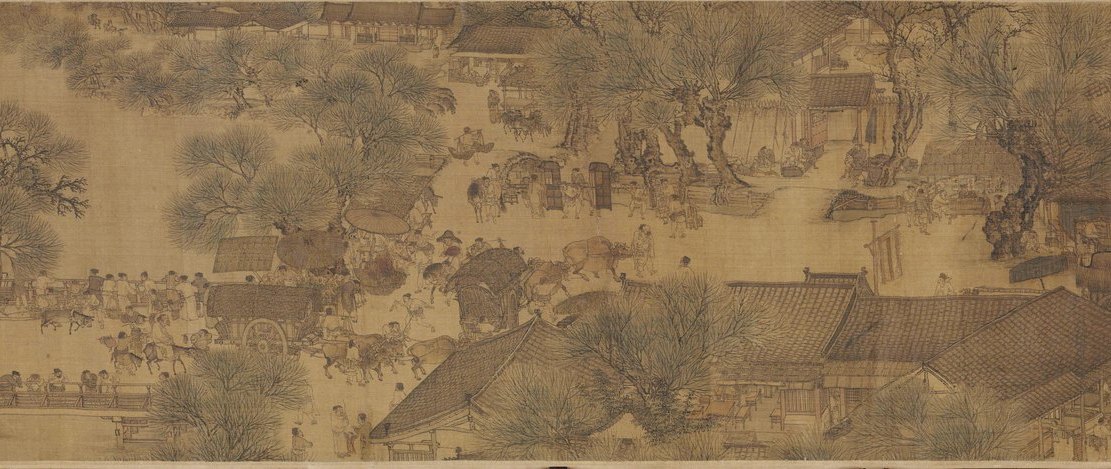
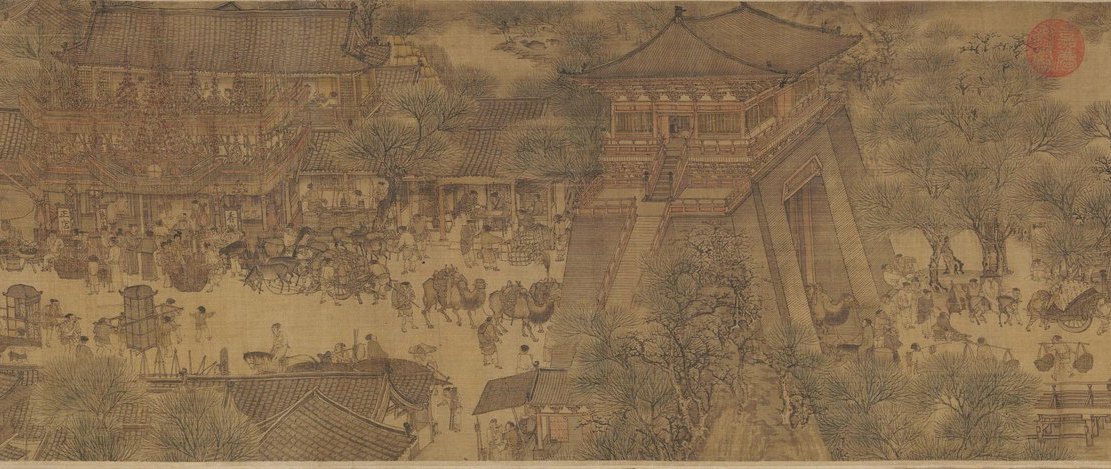
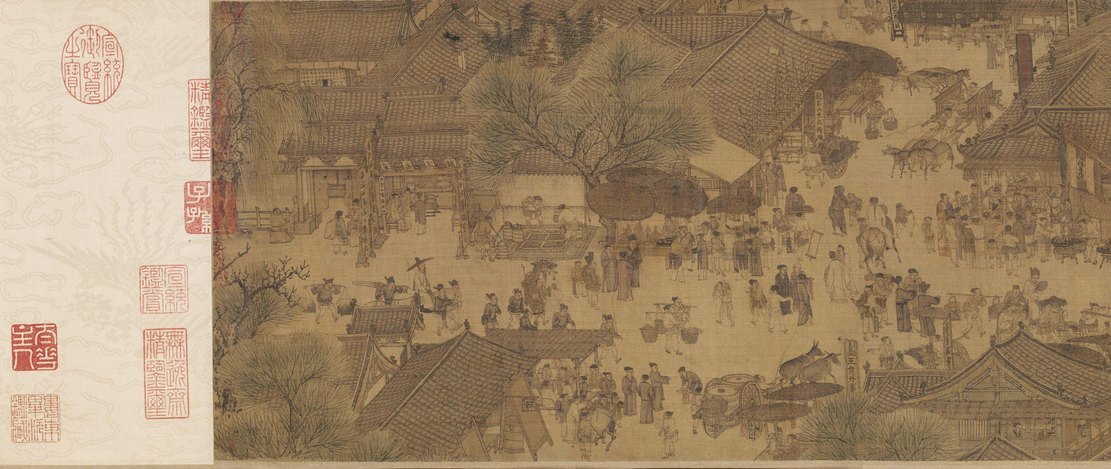
The panels below show the scroll in the order a reader encounters it. Because the original is read from right to left, the countryside comes first and the walled city comes last.


← Inside the city · endThis scan keeps the original orientation: the end of the scroll at the left, the opening at the rightCountryside · opening →
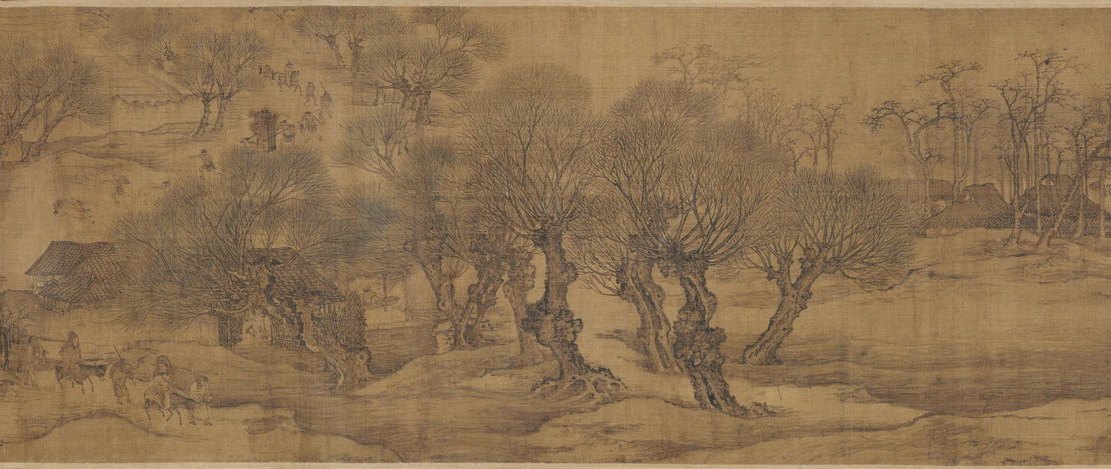
Along the River During the Qingming Festival — The Outskirts · Willows and a Pack Train
The Outskirts · Willows and a Pack TrainScroll position 75–100% · the opening

The scroll begins here, at the right-hand end: sparse trees, willows along the bank, and donkeys carrying charcoal toward the city. Figures thin out and the landscape opens. Beyond the last of the trees is blank silk and the mounting of the opening.

Direction. The public-domain scan used here keeps the scroll’s original orientation: the end of the scroll — inside the city — is at the left, and the opening in the countryside is at the right. Many modern printed reproductions are reversed so that they can be read left to right; this one is not. All positions quoted on this page refer to this scan.

Details

Nine details, same order

The whole scroll divided into nine equal parts

The scroll is cut here into nine equal segments so that nothing is skipped. Because the painting is read right to left, the first panel shows the very opening and the ninth shows the very end.
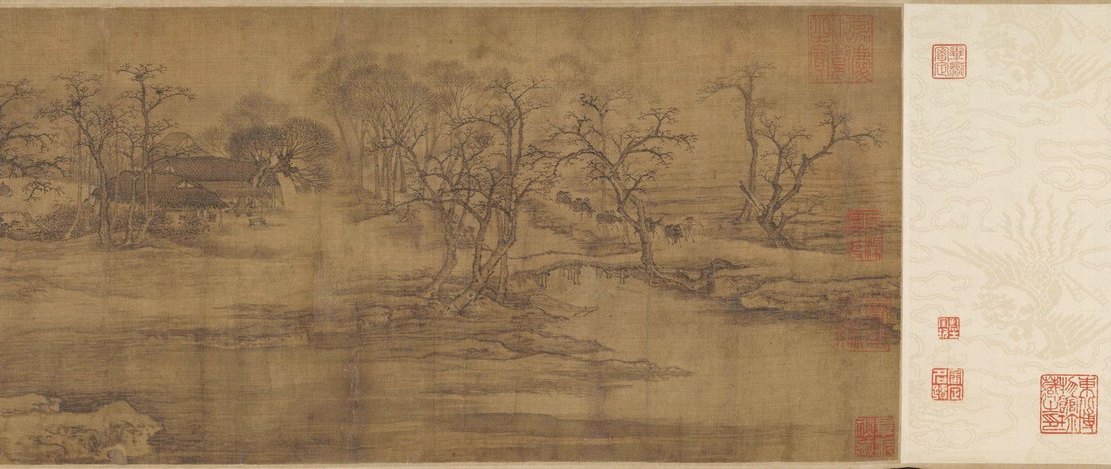
Detail 1 of the Qingming scroll — The Very Beginning · Sparse Trees and the Mounting
01The Very Beginning · Sparse Trees and the MountingPosition 88.9–100% · the openingAt the far right there is almost no human presence at all — just faint trees and a sloping bank, and then blank silk where the opening mounting begins. The narrative comes to rest here. Set against the crowding at the other end of the scroll, this is where the composition breathes out.
Detail 2 of the Qingming scroll — The Outskirts · Willow Bank and Pack Train
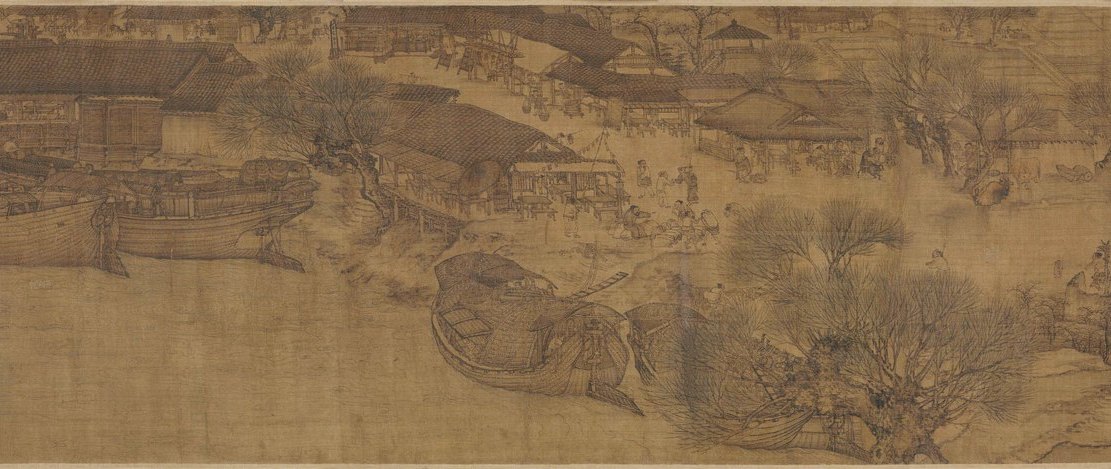
02The Outskirts · Willow Bank and Pack TrainPosition 77.8–88.9%Sparse woods, willows along the water, and donkeys loaded with goods. Figures grow fewer and the view opens up; fields and banks replace buildings. This is the countryside the scroll sets out from — sedan chairs carrying families out for the spring festival, households returning from tending graves, and pack animals bringing firewood into the city.
Detail 3 of the Qingming scroll — The Riverbank Docks
03The Riverbank DocksPosition 66.7–77.8%Boats lie moored along the bank, with houses, sheds and people moving between them. This is one of the landing places along the Bian canal: goods come ashore here and are carried on into the city by muscle and by animal. The supply of Northern Song Kaifeng was strung together out of places like this.
Detail 4 of the Qingming scroll — The Bian Canal · Grain Boats and Passenger Craft
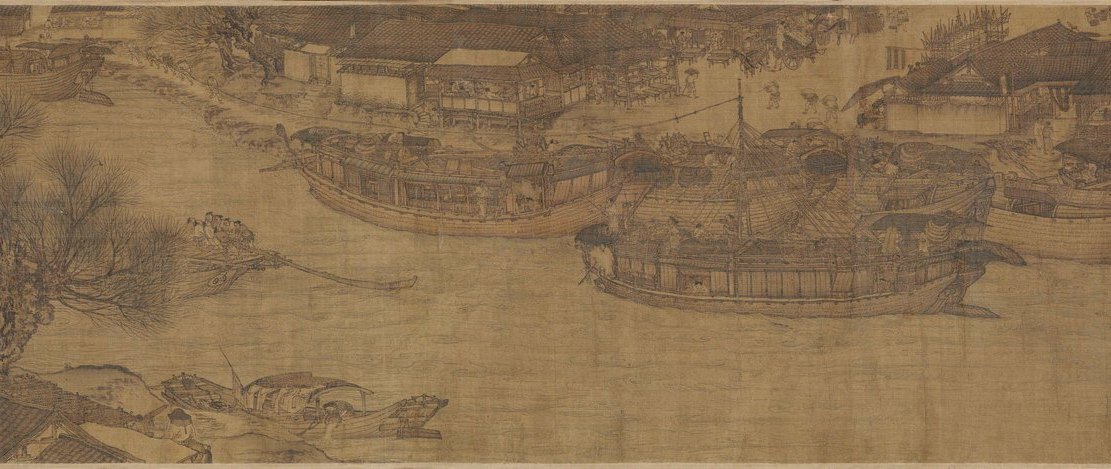
04The Bian Canal · Grain Boats and Passenger CraftPosition 55.6–66.7%The river is wide and packed end to end with vessels — grain barges under load, passenger boats for hire, masts standing in rows. The Bian canal was the city’s artery: millions of bushels of grain came up it every year to feed a population of over a million and a garrison of hundreds of thousands. To paint the canal was to paint the city’s lifeline.
Detail 5 of the Qingming scroll — The Rainbow Bridge
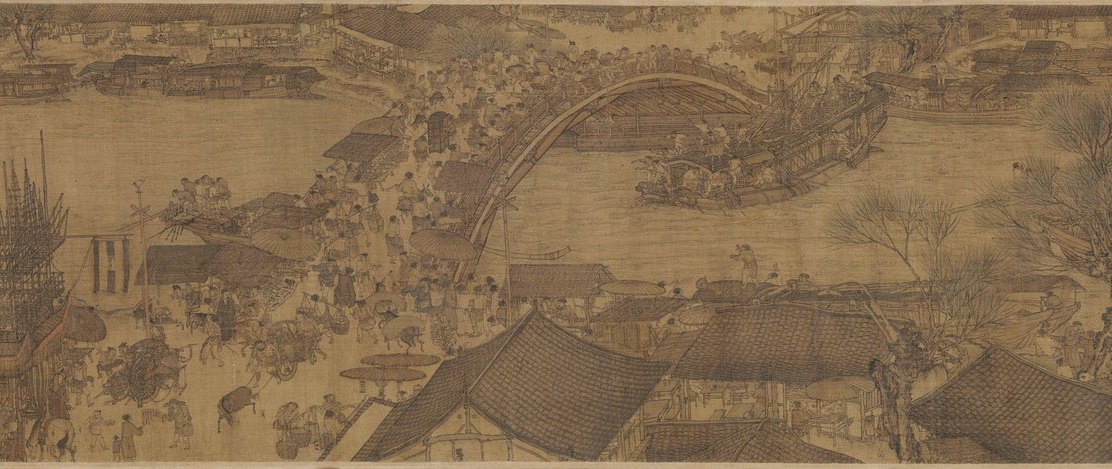
05The Rainbow BridgePosition 44.4–55.6% · the midpointThe centre of the scroll and its most famous passage. The bridge is a single timber arch with no piers, its interlocking beams spanning the whole river. Stalls line both sides of the walkway and onlookers lean over the rail. Below, a large vessel is about to pass under with its mast being lowered — the crew poling and shouting, the crowd above leaning out. An ordinary piece of navigation is staged as a public event.
Detail 6 of the Qingming scroll — Market and Riverbank · Shops and Moored Boats
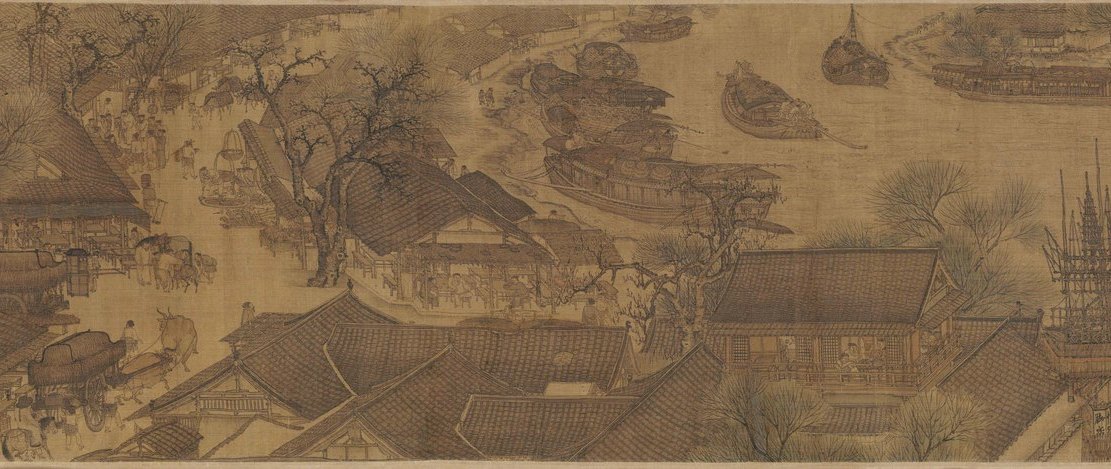
06Market and Riverbank · Shops and Moored BoatsPosition 33.3–44.4%The market loosens here: trees and open ground appear between the roofs, and the crowd thins visibly. Along the top edge of the painting you can already see water and vessels at their moorings. This is the transition from city to riverbank — a handscroll moves by changing density, not by cutting between scenes.
Detail 7 of the Qingming scroll — The City Market · Stalls and Porters
07The City Market · Stalls and PortersPosition 22.2–33.3%Stalls stand shoulder to shoulder along the street; carts, camels and porters crowd together; awnings and shop signs hang under the eaves. This is the most direct visual evidence for the disappearance of the ward system: shops open straight onto the street with no wall between them, and trade and housing occupy one continuous space.
Detail 8 of the Qingming scroll — The Gate Tower · Traffic Through the Arch
08The Gate Tower · Traffic Through the ArchPosition 11.1–22.2%A two-storey gatehouse with a double-eaved roof stands on a rammed-earth platform, with an arched passage below through which carts and pedestrians pass. This is the structural turning point of the scroll: inside the gate is the city market, outside it are the canal and the countryside.
Detail 9 of the Qingming scroll — The End · Collectors’ Seals and the Busiest Street
09The End · Collectors’ Seals and the Busiest StreetPosition 0–11.1% · the endOn the blank silk at the end of the scroll sits a column of collectors’ seals, immediately followed by the most crowded stretch of city street in the painting. The seals record the work’s near-millennium of ownership — it passed repeatedly between the court and private collectors, and each change of hands left a mark. Set this beside the first panel and you can see how the scroll opens and closes.